
Online Legal Advice from Insaaf99® Online Lawyer Consultation in India
Online Legal Advice from Insaaf99® Online Lawyer Consultation in India
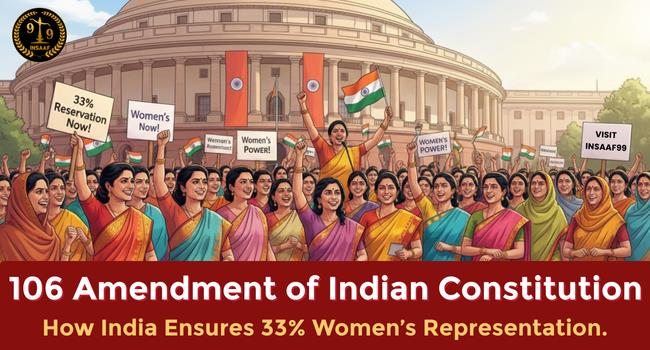
The 106 Amendment of Indian Constitution are important tools that enable the law of the nation to adapt to the times. They are dynamic instruments to enforce democracy, guard the rights of citizens and refreeze governance to new social realities. The Constitution in India has received many amendments in the decades that have passed by and they all indicate how India has been shifting towards inclusivity and equity.
A historic milestone in this quest is the 106th Amendment of the Indian Constitution in the year 2023. Plowed through as the Women reservation Bill 2023 or Nari Shakti Vandan Adhiniyam, it is a revolutionary move that guarantees women 33 per cent reservation in the Lok Sabha, State Legislative Assemblies and the Legislative Assembly of Delhi. The amendment is a historic move on the part of India towards gender parity in its move towards more inclusive and representative decision making.
The constitutional history of India is characterized by the constant development of the constitution with the help of the constitutional amendments which dealt with social justice, representation and equality. The need to have women’s representation in legislative houses has been in the democratic discourse over decades. Although the Indian women played a crucial role in the freedom struggle as well as post-independent politics, they continued to be grossly underrepresented in the Parliament and State Assemblies, with a level of around 14-15%.
Earlier efforts to have women reservations started in 1996 and as the 81st amendment which lapsed as Lok Sabha dissolved. However, it was subsequently re-introduced in 1998, 1999, and 2008. The 108th Amendment bill was passed in Rajya Sabha in March 2010, however, it lapsed in the Lok Sabha with the dissolution of the 15th Lok Sabha, meaning it could not be implemented. This was reinvented in the 106th constitutional amendment act 2023 which was fully bipartisan and eventually turned decades of advocacy into law.
Also Read :- The Advocates Act 1961
• What is 106 amendment of Indian Constitution?
The 106th amendment of the Indian Constitution is set to increase political empowerment of women by making one-third of the total numbers of seats in Lok Sabha, State Legislative Assemblies and even the Delhi Assembly. It is aimed at closing gender disparities in decision-making and improving a more representative system of democracy.
• Amendments to Constitutional Articles
Article 330A: It is equivalent to reserving one-third of seats in the Lok Sabha for women including a sub-quota within the SC/ST reserved seats to SC/ST women.
Article 332A: Provides for one-third reservation of seats for women in the Legislative Assemblies of all States, including seats reserved for Scheduled Castes (SC) and Scheduled Tribes (ST).
Amended Article 239AA: Provide one-third reservation of seats for women in the Legislative Assembly of the National Capital Territory of Delhi, including seats reserved for Scheduled Castes.
Article 334A: This gives the date of implementation - the reservation will become effective after the first delimitation exercise after the next Census (after 2029). It also brings in a 15 years sunset provision, which parliament may extend to a later date should it be necessary.
Key Objectives:
• Encourage institutional representation of gender.
• Enhance democracy by increasing the voice of women in policy making.
• Promote political involvement of women in the country and state.
• Meet the international obligations of CEDAW (Convention on the Elimination of All Forms of Discrimination Against Women).
Gender inclusivity in Politics.
The provisions of the 106th constitutional amendment act 2023 is a giant leap towards inclusive governance. The amendment is bound to change the political scene significantly with women having had only one-sixth of the parliamentary seats at the present. With more females involved, policymaking will be diversified, social welfare issues will gain more attention and the governance will be holistic.
For Legal Advice Online Contact Insaaf99
Women leaders present views based on diverse lived experiences- in most cases they are concerned with healthcare, education, child welfare and gender justice. This makes the law-making process more compassionate and moderate. The amendment makes a significant contribution to the democracy ideology by institutionalizing this depiction hence equal opportunity in leadership.
Global Comparisons
India is not the only country which has managed to use parliamentary gender quotas successfully:
Through constitutional provisions on reservation, Rwanda has the highest women representation, with more than 60-percent of parliamentary seats being occupied by women.
In Nordic countries such as Sweden and Norway, gender parity has been achieved by the political commitment and quota systems.
These illustrations demonstrate that gender quotas are not symbolic but have the transformational role of ensuring sustainable equality in governance. The fact is that the 106th amendment will bring India on par with these progressive practices.
Think tanks on policy and various organizations such as NITI Aayog and UN Women have been stressing on the idea that the representation of women is directly proportional to better governance rates and better integration into the economy. The Women Reservation Bill 2023 will be a victory of decades of advocacy based on global equality aspirations and constitutional equality.
This amendment of the Indian constitution 106 has been applauded as historic, the way to its implementation has not run smoothly:
Late Implementation: The amendment is subject to the following Census and delimitation process to be carried out after 2029, i.e. the 2034 general elections may not be accompanied by the benefits.
Limited Scope: The reservation is not applicable to the Rajya Sabha or the State Legislative Councils and so India upper houses are out of its sight.
Rotational Uncertainty: The cyclic nature of the seats assigned to the reserves would interfere with continuity among the female legislators in terms of long-term development of leadership.
In spite of these criticisms, the majority of the experts believe that the Amendment can be viewed as a stepping stone and not a final goal, in the way to gender parity in Indian politics.
Also Read :- How to Apply for a Surviving Member Certificate Online in India
The 106th Amendment of the Indian Constitution is a bright beacon in the democratic history of India-the commitment of the nation to equality, representation and empowerment. The Women Reservation Bill 2023 will change the constitutional structure of the Indian constitution into something more compatible with the principle of real participatory democracy by making the legislative bodies book 33 percent of the seats with women.
Even though the complete impacts of the reform will manifest themselves only upon delimitation, its enactment in 2023 is an indication of a new era of inclusive governance. With India coming up with its upcoming elections, this amendment may well spell out the new generation of leadership, one where women are equal partners in the making of the future of the largest democracy of the world.
FAQs:
Q1: What is the 107th Constitutional Amendment Act?
Ans: Removed Nagaland from the Sixth Schedule of the Constitution, as it already enjoys special autonomy under Article 371A. This ensured no overlap in provisions governing tribal areas.
Q2: What is the 108th amendment of the Constitution of India?
Ans: Proposed 33% reservation for women in the Lok Sabha and State Assemblies. It was passed by the Rajya Sabha in 2010 but laps without Lok Sabha approval.