
Online Legal Advice from Insaaf99® Online Lawyer Consultation in India
Online Legal Advice from Insaaf99® Online Lawyer Consultation in India
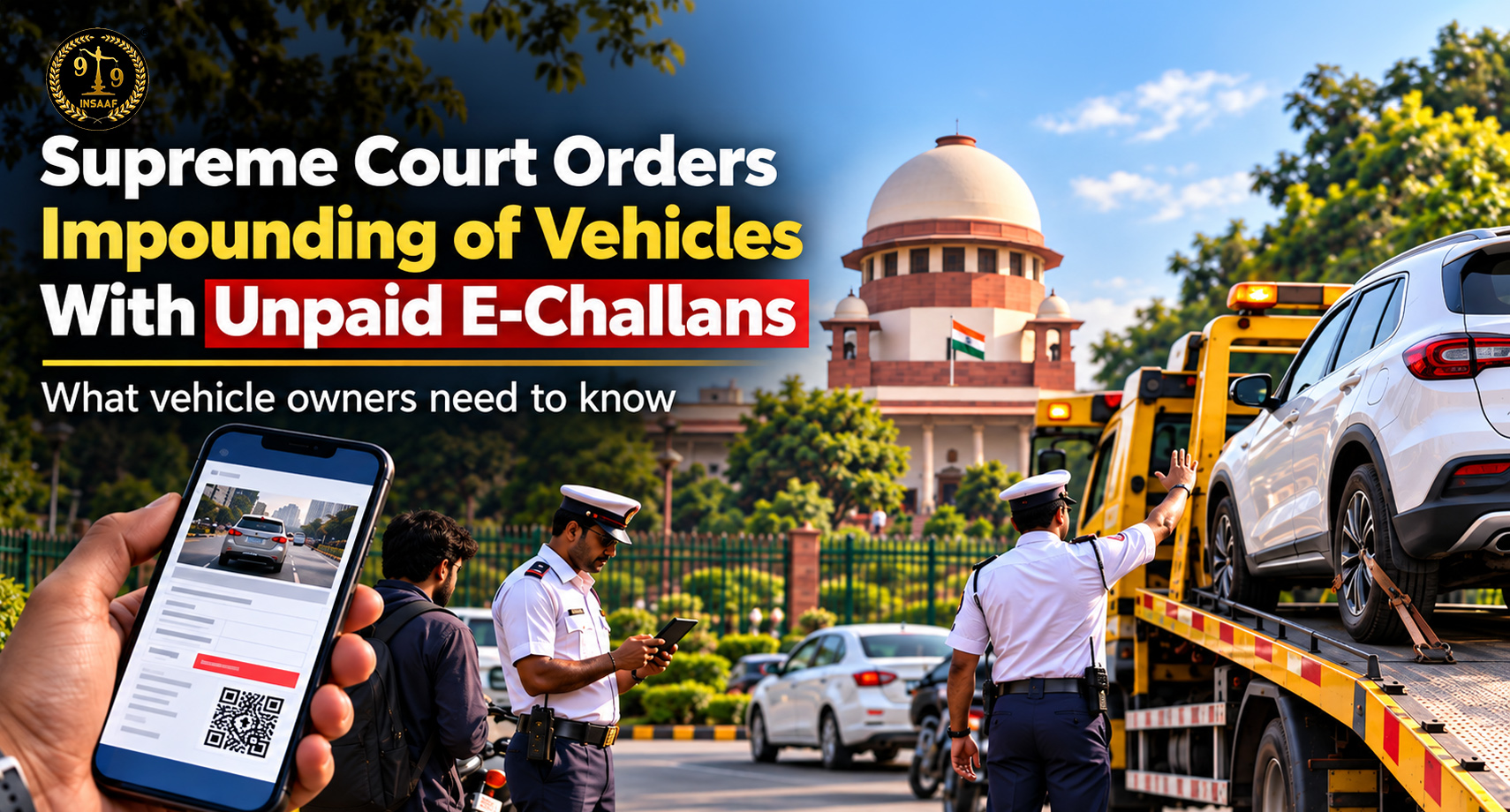
In its order dated 28 September 2026, the Supreme Court had directed all the States and Union Territories to impound vehicles detected in random checks that have outstanding e-challans and to also freeze the online vehicle services until the dues are settled. The Court pointed out that the country still did not have an idea of how much traffic fines have outstanding, which is approximately ₹23,000 crore.
In the road safety case The Court has been following since 2012, ‘S. Rajaseekaran v. Union of India', the Bench of Justice J.B. Pardiwala and Justice K.V. Viswanathan gave the direction. It believed that issuing of e-challans would be futile if the fines are not recovered and directed for random vehicle check. Where a challan is issued on the computer, the necessary steps must be taken to impound the vehicle if it is not paid.
The Court was informed that there were e-challans issued in all over the country for recovery of approximately ₹49,194 crore, out of which recovery of Rs. about ₹26,175 crore was made. This means that the shortfall in funds is approximately ₹23,000 crore or the headline number in the news reports.
The Court prescribed the steps that State and UTs have to take to recover dues:
• Suspend online services for any boater with unpaid fines
• No renewal of registration certificate, No issue of duplicate RC
• No update of the address to the owner or other information
• Refusal of fitness certificates until all fines are paid.
• The Facility of Blacklisting on Parivahan Portal makes it difficult to sell the vehicle.
• Refusal to allow transfer of ownership blocked.
• Suspension of multiple driving license renewals, steps towards suspension already put in place
• Even with no PUC certificate issued by any testing centre in the Philippines for such vehicles.
Also Read :- The Importance of Traffic Rules: Ensuring Road Safety and Order
Typical practice is to send unpaid e-challans to the court of law for recovery. The Court realized that that was not enough as there were lots of challans. It also cautioned that if the directions are kept on paper, they have little value, and it could take drastic measures if authorities are not implementing them.
AI-enabled enforcement. The States/UTs, the National Highways Authority of India and other road owning agencies should ensure that the electronic enforcement systems are equipped with AI features and are capable of detecting the 12 categories of violations specified in Rule 167A(3) of the Central Motor Vehicles Rules, 1989.
Data integration. While implementing the Ministry of Road Transport and Highways (MoRTH) Standard Operating Procedure of 28 October 2025, the Ministry must examine how the NCRB's October 2023 recommendations can feed a supplementary action plan under Section 136A of the Motor Vehicles Act. The proposed framework involves the establishment of a National Road Safety System, and interoperable integration of VAHAN-4, SARATHI, e-Challan, e-DAR, IRAD and traffic control rooms.
Public dashboard. MoRTH has to establish an online dashboard with details corridor-wise and State/UT-wise with at least a monthly update, which contains the following information: corridors where electronic enforcement is in place, number and status of the electronic devices, type of violations monitored, violations detected versus e-challans generated. The data may also be available in MoRTH's "Road Accidents in India" report for the year.
At the hearing the Court indicated that electricity bills could be used to recover pending dues. This was a verbal statement and not part of the uploaded direction and therefore is not a binding direction at this stage.
An unpaid e-challan can prevent the normal processing of tasks like renewing the registration, fitness certificate, PUC certificate and even selling the vehicle. Owners should:
• Login to the official e-Challan or Parivahan portal and view upcoming challans.
• Pay or challenge dues in a timely fashion via the established procedure.
• Have proof of payment as unexpected checks might flag for unpaid challans.
Implementation will depend on how each State and UT issues its own instructions, so exact procedures may vary.
Key takeaways
Case: S. Rajaseekaran v. Union of India
This case has been heard by Justices J.B. Pardiwala and K.V. Viswanathan of the Delhi High Court.
Order date: 28 September 2026
Unrecovered fines: It is estimated to be around ₹23,000 crore. Collaborating with traffic police: random checks and impounding vehicles with unpaid e-challans
Other things that are added: Service freezes, Parivahan black listing, No fitness, No PUC certificates, No transfers of ownership.
Systemic directions: AI-enabled enforcement, data integration and a monthly public dashboard
Also Read :- MACT Cases: Motor Accident Claims Tribunal, Relevant Act, and Compensation Calculations
Q1: Is impounding my car possible for an unpaid e-challan?
Ans: If the vehicle is detected with an unpaid e-challan during random inspections, it could be impounded, the Supreme Court has directed. This will be left to the discretion of the states and UTs.
Q2: Can I sell a car on which there are pending challenges?
Ans: The Court had ordered blacklisting of the Parivahan Portal and blocking of the transfer of ownership in the portal, thereby barring the sale of the vehicle till the dues are recovered.
Q3: Is it possible to get a PUC or fitness certificate without paying the fines?
Ans: No. The Court said that fitness certificates should not be issued till all pending fines are settled and no testing centre should issue a PUC certificate for such vehicles.
Q4: What are the steps to see pending e-challans?
Ans: Enter details of the vehicle or Challan on the official e-Challan portal or the Parivahan portal.
Q5 Will electricity bills provide a recovery for fines?
Ans: It was only a suggestion, not an order, during the hearing.