
Online Legal Advice from Insaaf99® Online Lawyer Consultation in India
Online Legal Advice from Insaaf99® Online Lawyer Consultation in India
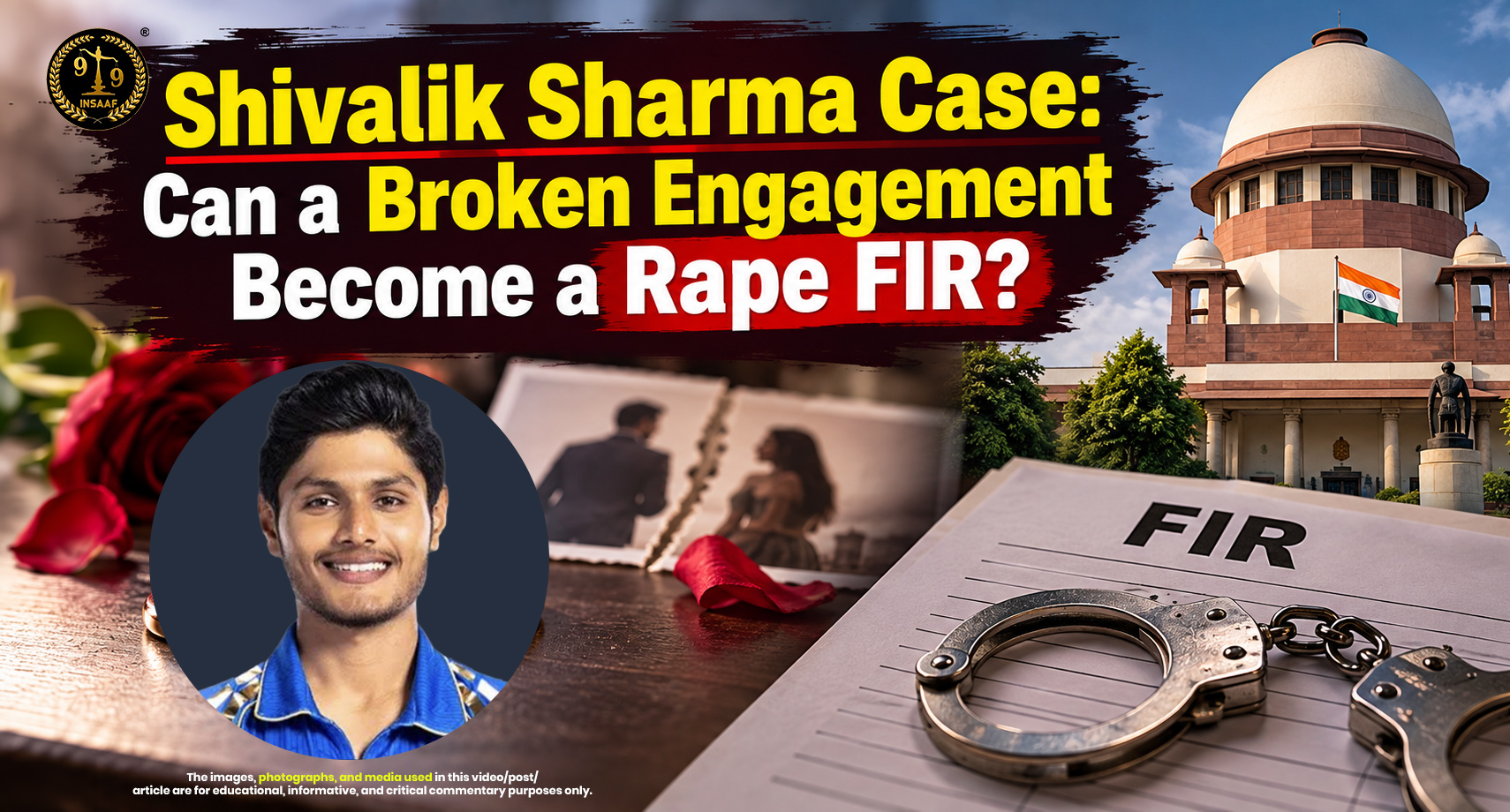
As per Section 69 of the BNS, 2023 the promise of marriage must have been false from the start and must have induced the relationship. The Rajasthan High Court has reportedly issued this reasoning in quashing the FIR against cricketer Shivalik Sharma.
Table of Contents
• Background
• Claims
• The ruling
• The law
• Takeaways
• FAQs
Shivalik Sharma, the Baroda cricketer at the centre of this Rajasthan High Court case, is a left-handed batter from Vadodara. Born on 28 November 1998, he made his first-class debut in the 2018–19 Ranji Trophy and has a highest first-class score of 188. He was picked by Mumbai at the 2024 IPL auction.
Also Read :- Protecting Rights Against False Promise of Marriage
It was reported that the two met in 2023, they became a couple with both families involved. They formally got engaged in August 2023, and reportedly had physical relations afterwards. The ties later grew strained and the marriage did not take place.
The lady lodged a case at the Kudi Bhagtasni Police Station, Jodhpur. Sharma was arrested and given judicial custody, after which he approached the High Court for quashing the FIR.
His side says the dispute began after his IPL selection, when the woman's family allegedly demanded 50 lakhs. They say the FIR followed after he declined the alliance. They also say he spent about three weeks in jail and his family suffered for nearly two years. I could not confirm any of this in published reports.
Disputed
An earlier arrest report quoted police saying his parents called off the engagement in August 2024, and that she filed the FIR afterwards. Until the judgment is available, which version is accurate remains unclear.
The Court reportedly stated that the parties were adults, the couple had been known to their respective families and had been engaged. They also continued to send messages on WhatsApp when issues arose, and there were financial transactions between them.
It is said to have stated that if a subsequent breakdown is not enough to make a consensual relationship between engaged adults a rape.
Section 69 BNS and related provisions
| SN | Provision | What it covers |
| 1 | Section 69 BNS | Sex obtained by deceit, including a promise to marry never meant to be kept. Up to 10 years and a fine. |
| 2 | Section 69 BNS | Rape and its punishment (formerly IPC 375 and 376). |
| 3 | Section 69 BNS | High Court's inherent power to quash proceedings (formerly Section 482 CrPC). |
| 4 | Section 69 BNS | False charge made with intent to injure (formerly IPC 211) |
Two questions are being asked by the courts: was the promise false and made in bad faith, and did it directly induce the relationship? The Supreme Court draws the line between a promise that is false from the outset and a promise that is false because of changed circumstances. Duration, openness and subsequent behaviour are all counted.
There is still no automatic quashing. The Delhi High Court has made it clear that a mini-trial cannot be conducted in a High Court and that it would be intervening only if defence material completely demolishes the prosecution case.
Section 69 has been drafted to cover those people who are truly misled into a relationship. There are other sides to the debate, too, and this case is a prime example: A complaint filed after an engagement was unsuccessful can result in arrest well before anyone can verify the facts. Thus, courts consider the entire relationship, and not just the allegation.
It's fair to say that there is a media imbalance. There's a lot of news about arrests and not so much about a quashing order. The most effective way to correct this is to report the arrest and judgement accurately, and include both the arrest and the result without assuming the complainant's motives.
Key takeaways
• There is no such thing as a broken engagement becoming rape.
• The evidence on which courts rely is open engagements, family involvement, messages and money trails.
• Arrest and custody is not followed by relief, that's why the process is seen by many as a burden.
• Quashing is not automatically a finding that the complainant acted with malice.
• The complaint is still actionable for genuine deceit under Section 69.
Also Read :- Court Marriage Process in India: Step-by-Step Legal Guide
FAQs
Q1: Did the Rajasthan High Court quash the FIR against Shivalik Sharma?
Ans: As per reports Rajasthan High Court did quash the FIR.
Q2: What is the meaning of Section 69 of BNS?
Ans: It censures sexual intercourse which is procured through some dishonest means such as agreeing to marry with no intention of keeping that commitment, punishable by up to 10 years and a fine.
Q3: Is a broken engagement rape in India?
Ans: No. Courts expect a false promise from the outset that it was what had spurred the relationship.
Q4: Whether High Court can quash a rape FIR in its absence of trial?
Ans: Yes, where there is a limited situation, like abuse of process, under Section 528 BNSS.
Disclaimer
This article is for general information only and is not legal advice. It is based on news reports and commentary, and we have not independently verified the judgment text. Points in grey are claims or unverified details, not confirmed facts. A court order quashing a case is not a finding against either party's character. Please read the original judgment and consult a qualified advocate before relying on this content