
Online Legal Advice from Insaaf99® Online Lawyer Consultation in India
Online Legal Advice from Insaaf99® Online Lawyer Consultation in India
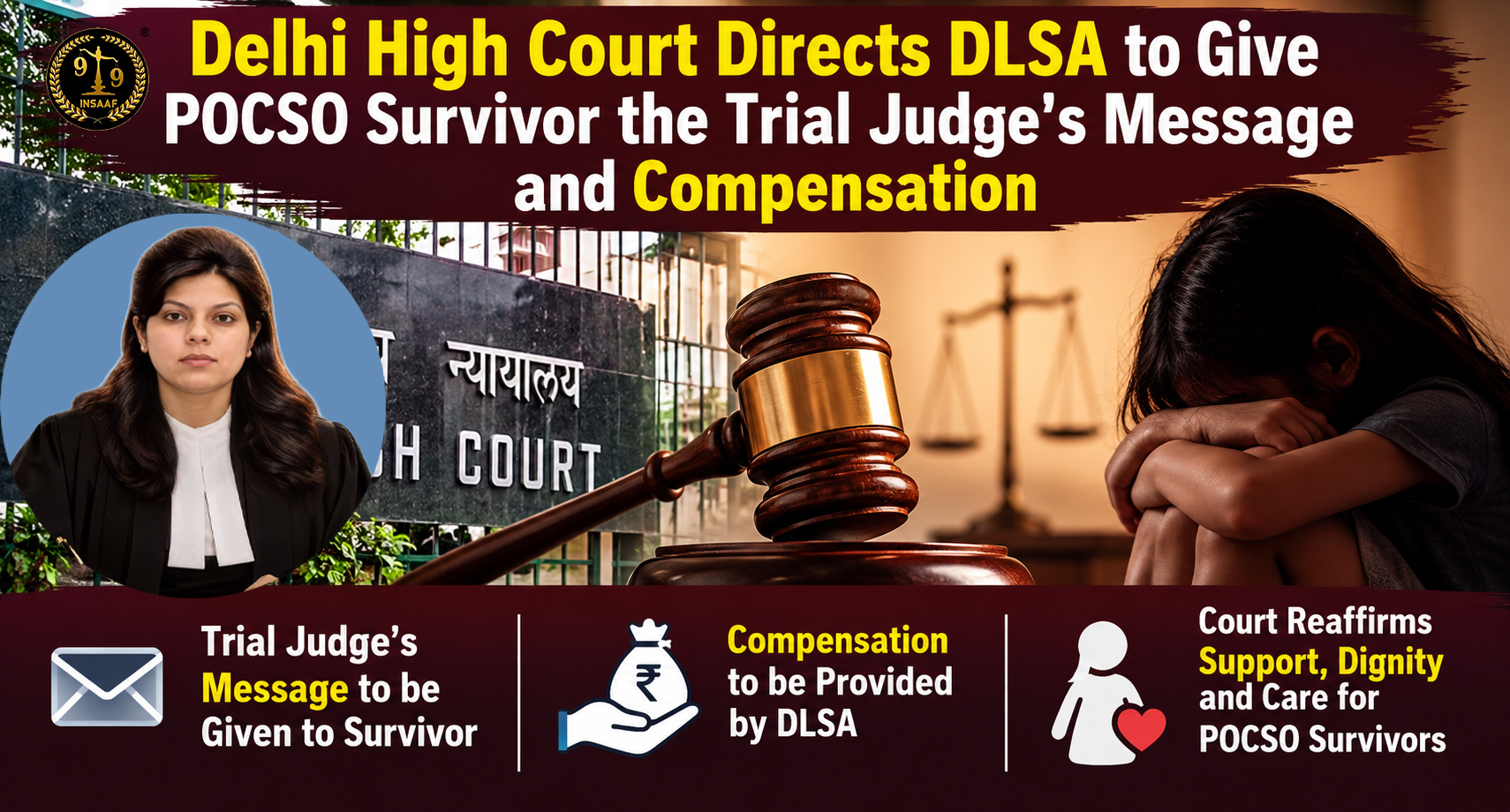
The Delhi High Court, on 22 September 2026, ordered the District Legal Services Authority (DLSA) of North-West Delhi to display a poignant message penned by a trial court judge, in addition to awarding her Rs 10,50,000 compensation, to be handed over to a 10-year-old girl survivor of the POCSO Act in two weeks.
A Division Bench of Justice Prathiba M. Singh and Justice Dinesh Bhatt in CRL.A. 849/2026 directed the Secretary of DLSA to print the DLSA Secretary's post scriptum and hand it over to the trial judge or any member of her family, along with the compensation. This is a deadline 14 days after the order. The Bench called the message one of encouragement.
Sumit Shakya had filed the appeal against Section 415(2) of Bharatiya Nagarik Suraksha Sanhita, 2023 (BNSS). This challenges a conviction and sentence awarded by the Additional Sessions Judge-01 (POCSO), Rohini, North-West, in an FIR case at Budh Vihar police station. It happened on 23 July 2023 when the survivor was approximately seven years old.
He was found guilty of: Aggravated penetrative sexual assault against a child below 12 years as per Sections 6 and 5 of POCSO Act and IPC provisions.
Criminal Intimidation IPC 506
The sentence was rigorous imprisonment for life (remainder of natural life) and also five years' rigorous imprisonment for intimidation to run concurrently. If they are recovered, the money is given to the child to compensate him or her.
Ms. Rajani Ranga, Additional Sessions Judge-01 (POCSO), North-West, Rohini, ended her sentencing order by addressing the child directly. She wrote that she was speaking "not in the formal language of a judgment but as a judge who has heard her voice, who has read her words, and who has been moved by her courage." The message reads:
“Dear Child,
"Beta, this Court heard you. When you said Jab tak uncle buddhe na ho jaaye, tab tak unhe jail mein hi rakha jaaye, this Court listened. And this Court has answered your plea.
Today, this Court has ordered that the man you called 'uncle' will never walk free again. He will live in a cage for the rest of his life. He will grow old in that cage. He will die in that cage. He will never be able to hurt you, or your little sister, or any other child, ever again.
You are the bravest little girl this Court has ever seen. You came to Court, you pointed at the man who hurt you, and you told the truth. The man you called 'uncle' did a very bad thing to you. But you did not stay quiet. You told your mother. And because you had the courage to speak, he will never be able to hurt another child again.
This Court cannot give you back your childhood. But the Court can promise you that your words have been heard. Your plea has been granted. The man who hurt you will never see the sun as a free man again.
Now, beta, live your life. Go to school. Make friends. Laugh. Play. Dream. This Court will always remember your courage."
The Hindi line quoted in the message translates roughly as: "Keep uncle in jail until he grows old."
Also Read :- What is POCSO Act 2012 - The Protection of Children from Sexual Offences
The trial court had granted ₹10.50 lakh based on Section 33(8) of the POCSO Act and Rule 9 of POCSO Rules, 2020. It had decided that the nature of the crime was sufficient to warrant the maximum compensation allowed by law and that the suffering to the child and the lifelong consequences of the crime was warranted. The High Court has directed the DLSA to submit a status report to assure that the compensation is delivered to the family.
The order is important because there are three reasons for it:
• Treats the child as a person, not just a case. Courts rarely speak directly to survivors and making it known acknowledges her courage.
• It puts the delivery of compensation on a timeline. Families typically are not reached by the victim compensation in time. A status report and two weeks' time creates accountability.
• It strengthens the importance of DLSAs. This order gives flesh on the bones of the legal services authorities' role in implementing victim compensation.
No. Appellant also had requested for bail and suspension of sentence during appeal. Given all the evidence, including the forensic evidence, the Bench was not inclined to suspend the sentence at this time. He still has to wait in jail until the appeal is resolved.
The additional public prosecutor also received a notice of the State.
• A letter to the survivor using the Investigating Officer
• Status report from the DLSA on compensation.
• The latest nominal roll of appellant from the jail authorities.
• Appeillant's affidavit of past criminal antecedents in light of High Court's Practice Directions in the light of Supreme Court's decision in Zeba Khan v. State of U.P.
• Registry will be needed to provide trial court records and prepare an indexed, digitised paper book
• The DLSA status report will be considered on 4 November 2026.
• 20 January 2027: hearing of the appeal
Key takeaways
• Case: Sumit Shakya v. State of NCT of Delhi & Anr., CRL.A. 849/2026
• Both the bench had Justice Prathiba M. Singh and Justice Dinesh Bhatt.
• Order date: 22 September 2026
• Appeal sentence: life in prison for the rest of life.
• Compensation: ₹10.50 lakh
• Direction: DLSA to deliver the judge's message with the compensation within two weeks
• Sentence suspension: refused
Q1: In Delhi, who will bear the liability to pay compensation for the victim of the POCSO Act?
Ans: The trial court grants it under Section 33(8) of the POCSO Act and the POCSO Rules, 2020 and it is the duty of the District Legal Services Authority to ensure that it is released to the victim.
Q2: Is the identity of the POCSO survivor disclosed?
Ans: No. As per legal protection afforded to minors in such circumstances, the survivor is referred to as only the child or survivor.
Q3: Can a convict under POCSO get bail during appeal?
Ans: If someone has been convicted they may request a sentence be suspended, but the courts will consider the evidence. The High Court, in this instance, rejected the offer, bearing in mind the evidence, including forensic evidence.
Q4: Is the conviction final?
Ans: No. The appeal is still pending and the High Court has only accepted it and issued notice.