
Online Legal Advice from Insaaf99® Online Lawyer Consultation in India
Online Legal Advice from Insaaf99® Online Lawyer Consultation in India
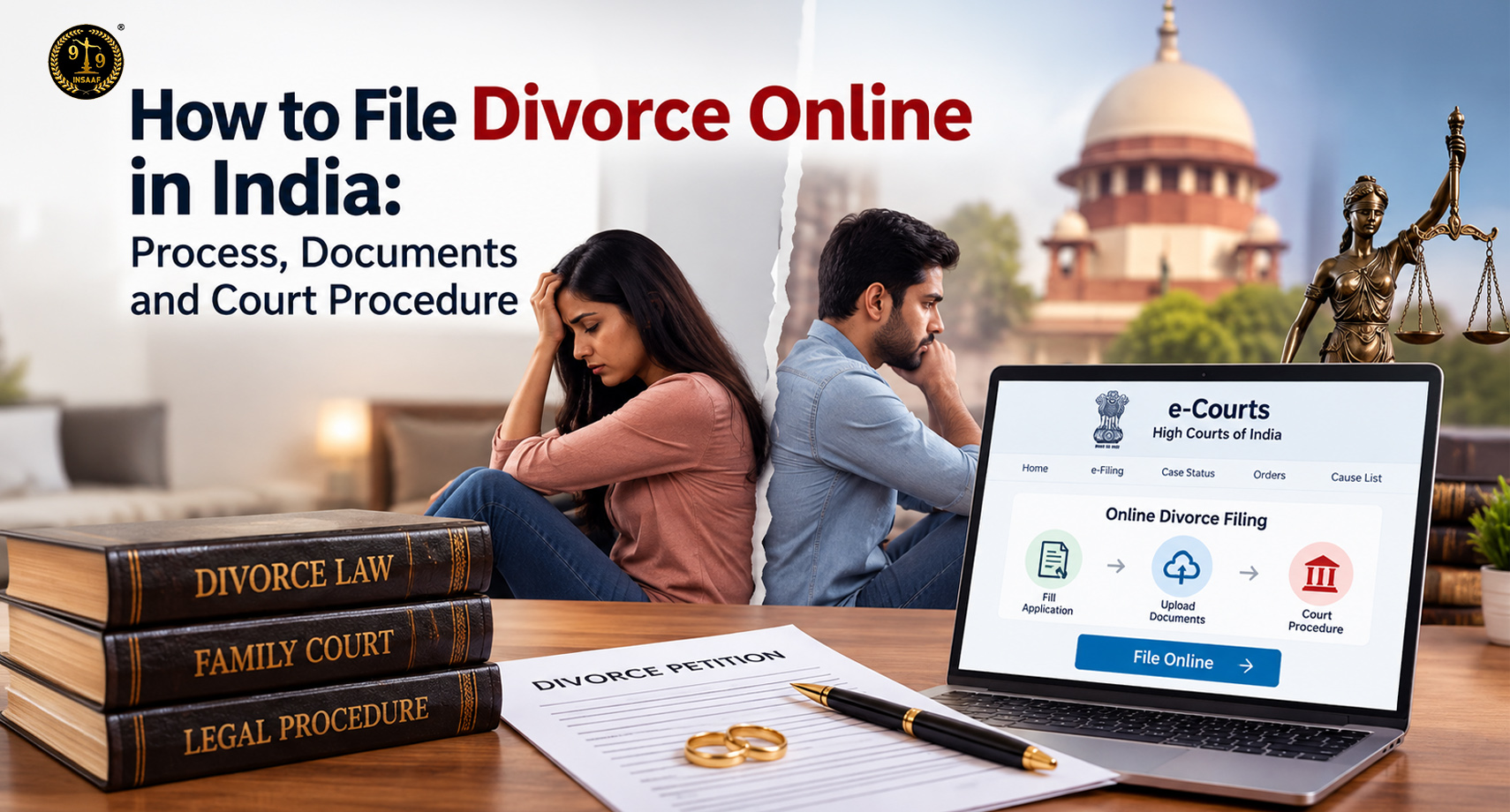
If you have ever searched “how to file divorce online”, you may have been hoping to find one website that you complete a government authorized form at and receive a divorce. The website does not exist. There is a hybrid system for this: an official e-filing system some courts have implemented, online legal support to draft and advice, and a court procedure where the petition must be delivered to the appropriate Family Court or District Court. Divorce applied online in India is not an alternative to the court, it's a means of using these tools. In this article we will cover exactly what "online" means, what does not change, and what you have to do.
An entire divorce decree cannot be obtained online without going to court. What you can do online is, consult a lawyer, get your case assessed and your petition and papers prepared online, and submit the petition online to the concerned court where they have adopted the e-Filing system, which is run by the e-Committee of the Supreme Court of India. The court is still checking up on the case, giving notice and normally requiring some appearance to grant a decree. It's not that online is taking the place of the court, it's about how you connect with your lawyer, how the paper moves.
The hardest part of a divorce usually isn't the law — it's knowing which law applies, which court to approach, and how to avoid mistakes that cause delays. Hiring a lawyer online helps by:
Allowing you to speak with them on the phone or through a video call.
An online lawyer cannot guarantee a specific time frame, cut corners on legal procedures or eliminate court proceedings that do not require physical presence. Their value is that they make the tasks a bit smoother, not a route around the system.
Also Read :- Divorce Papers India? Who can file for Divorce in India?
Insaaf99 platforms are designed on a single concept: that of linking people to practising lawyers digitally without having to go to an office. This is often the first step that leads to moving forward when someone is working out how to apply for divorce online. In reality, this type of platform usually alleviates the following:
Connect you with a lawyer who is right for your case for your practice type (family and matrimonial law), experience level, and, in some cases, language, to avoid speaking with someone who is not very familiar with divorce.
Things to note about this type of platform is it's a convenient online means to communicate with an attorney and begin the process. It does not file your case, make your case, represent you at court, or guarantee a certain outcome or timeframe.
Most people use mutual consent divorce if they both agree to divorce. This requires a joint petition, a resolution of issues such as alimony, custody, property, etc., a first motion, a statutory waiting period (usually for six months but is directory and can be waived at the court's discretion as per Amardeep Singh v. Harveen Kaur (2017) and Shilpa Sailesh v. Varun Sreenivasan (2023)), a second motion, and the final decree in accordance with Section 13B of the Hindu Marriage Act, 1955.
When one spouse wants to divorce or they disagree on the conditions, it's called contested divorce. The petitioner will have to state recognised legal reasons, a response will be a written one to reply, mediation may be required, evidence will be required, hearings will be held and a judgment will be issued (this is a longer process than mutual consent cases).
Marriage Laws Governing Divorce in India
Errors in the initial steps of the law might lead to a real delay, which is yet another benefit from getting legal advice early in the process.
There is no one single online divorce application form in India which is valid for all situations. There's merely a breakup petition written for your marriage law and court, and, if your state has one, an e-filing interface to submit the petition electronically. You don't fill out a standard form, a lawyer engaged online would fill it out and submit it.
Documents Required for Online Divorce Filing
Requirements vary by case; your lawyer narrows this down based on your facts.
Costs are usually comprised of court fees, which are imposed by the state and are generally very low for matrimonial petitions, and lawyers' professional fees, which depend on their experience and the type of case. If you book a consultation online, you won't incur the travel or repeat-visit expenses, but there isn't a standard nationwide rate, so be sure to get the fee structure in writing before you book a consultation.
There are no fixed schedules. Conditions of mutual consent cases proceed more quickly, but include a statutory waiting period unless waived. The length of time for contested cases varies, depending on the hearings, settlement and workload of the court. Having a lawyer on your side early will cut back on missing documents and other filing delays, however, there is no guarantee of the length of the process.
Not entirely. A lawyer can attend a variety of hearings, and in certain cases, the lawyers may appear by video-conferencing if the court allows, but in most cases, the lawyer's presence is required at important hearings, such as the initial and second motions in cases where the parties agree to the case going to trial. Online legal representation does not eliminate the need to attend court when required but does decrease the number of court appearances.
If a spouse does not appear or cannot be found, once the court is satisfied that it has served the notice properly, the case may be heard ex-parte — without the spouse's presence. It is not a ground of divorce in itself; as per Section 23 of Hindu Marriage Act, 1955 the court has to be convinced that a valid ground is proved, even in the absence of opposition. The absent spouse can challenge the decree later in the case of an ex-parte decree, Order IX Rule 13 of the CPC, 1908, rendering such a decree even when it does not get cross-examined or evidence is not placed before them, provided they establish the issue of improper service and/or sufficient cause for their absence, within the time limit. The online lawyer is helpful for petitioners when they need to ensure there's proper service as well as for respondents who want to take action immediately after they receive notice of an ex parte decree.
Here is a short list of things to avoid for a smooth legal experience
Most importantly, hiring a lawyer online does not mean getting rid of any court appearances, if you think so, then you are wrong. You cannot assume that an online lawyer will eliminate all court appearances.
Also Read :- Types of Talaq in Muslim Law: Divorce in Islam
Q1. Can I file for divorce online in India?
Ans: Yes, one can file for divorce online in India. A lawyer can be consulted, documents can be prepared and in the courts that offer e-filing, the petition can be e-filed. The case is not completely resolved online, but is still resolved by a Family Court or District Court.
Q2. How to know the online Divorce Laws in India?
Ans: Get a legal consultation with the lawyer online, verify the applicable marriage law and proper court, and obtain the lawyer to draft, e-file (if permitted by law), and represent you at hearings and motions.
Q3. Does the state have a divorce application form online?
Ans: There is no one, universal form. The petitions are prepared by a lawyer (not you) for the appropriate law and court.
Q4. Can I divorce my spouse without going to court?
Ans: No you cannot. Though a lawyer may minimize the frequency of your appearance, in most cases personal appearance is still required at the critical stages.
Q5. Is there an online option to file a mutual consent divorce?
Ans: All of the petition can be e-filed (if supported by the court), but the first and second motions and the statutory waiting period (unless waived) continue.
Q6. What is the duration of online divorce in India?
Ans: There is no fixed time limit, usually contested cases will take longer depending on disputes and court schedules, and mutual consent will take faster.
Q7. What is the expense of divorce?
Ans: The fee is for the state's courts and will depend on the specific case and the fees charged by the lawyers. There are no estimates of the national level.
Q8. What happens if my spouse doesn't respond to the divorce notice?
Ans: If the Court finds that proper notice has been given, the case may proceed ex-parte. This is not a no-fault divorce; the grounds must still be established and the absent spouse may later seek a setting aside of the decree if they were improperly served.