
Online Legal Advice from Insaaf99® Online Lawyer Consultation in India
Online Legal Advice from Insaaf99® Online Lawyer Consultation in India
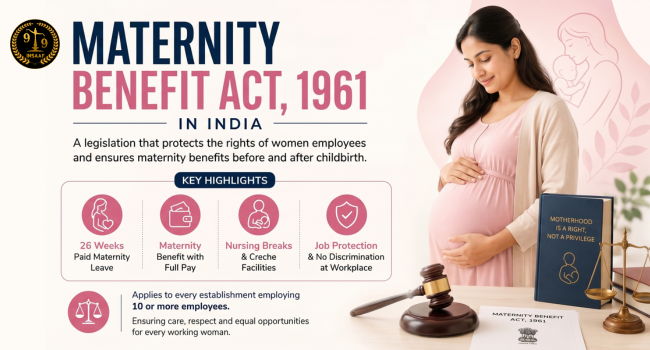
The culture of a society tends to be very indicative of its attitudes towards working women, care and dignity. Maternity protection in India has never been a sole welfare initiative, but it has been an expression of intent. The Maternity Benefit Act is at the crossroads between labour law and public health as well as gender equality and economic participation. Since the law started in post-independent times India, and has been dramatically changed with the Maternity Benefit Act, 2017, it has been modified with the changing workplaces, social expectations, and realities working women encounter.
This evolution is important to understand and not only by the employer or legal practitioners, but by everybody who is interested in how law changes to suit the needs of man.
Pregnancy and birth are a biological fact, but its economic and occupational implications are highly social. Maternity is easily turned into a penalty in the career without any legal protection. Forced exit out of the workforce, loss of wages, insecurity at the workplace, and poor health were certain issues faced by working Indian women.
Maternity benefits are set to avoid this. They strive to make sure that a woman is not forced to decide between her living and her health or between her and her child's well-being. The Maternity Benefit Act at the most fundamental level acknowledges maternity as a societal role, but not an individual inconvenience.
Also Read: She Box - Workplace Harassment Complaints Portal
Prior to independence, maternity benefits in India were disjointed. There were some princely states and industries and establishments that provided limited protections but there was no standard. With the development of the labour system in India, after 1947, when India started forming its own labour structure, maternity protection became a constitutional issue. The Directive Principles of the State Policy encouraged the State to provide humane working conditions and maternity relief.
The Act of 1961 was an innovation during that era. It was applicable to factories, mines and plantations, shops and places where there were a number of workers. But more importantly it made maternity benefit a right not an employer discretion.
The Maternity Benefit Act, 1961 has several features
The initial Act came up with a number of fundamental safeguards that were ahead of their time.
It provided a set maternity leave where payment continued even when pregnant and after child birth. It barred employers against firing/disfavouring women on maternity leave. It limited hard labour and unsafe activities in the course of pregnancy. It also forced some medical and nursing benefits which are related to childbirth.
The Act was also dependent on the previous employment history and benefits were available to women with a fair period of employment. The legislation tried to balance the welfare of employees to the responsibilities of the employers, but, in retrospect, the balance was too one-sided with economic assumptions of another era.
The Shortcomings of the 1961 Framework
Although the Maternity Benefit Act, 1961 was a radical act, it was not eternal.
The most obvious constraint was the time of maternity leave, adjusted to older medical and social myths on child birth and recovery. With the development of medical science, it was obvious that the first care of the mother, breastfeeding, and physical healing needed more permanent assistance.
Another aspect of the workforce that was prevalent in the Act was that of a highly industrial and location-bound workforce. It never expected the emergence of corporate offices, service sector jobs and two-income families. The workers that comprise the informal sector which constitute a significant segment of the female workforce in India were mostly beyond its sphere of influence.
Maternity Benefit Act, 2017 Background.
The Maternity Benefit (Amendment) Act, 2017 has not come out of the thin air. It was informed by various forces.
The female workforce in India was becoming more educated as well as professionally diversified. Indicators of maternal health focused on the role of postnatal care and breastfeeding. The discourse of equality in the workplaces and the paternal-hygiene relationship was becoming more popular globally. On the domestic side, the courts and policymakers started acknowledging the fact that the old maternity laws would involuntarily make women quit jobs altogether.
The 2017 amendment was an effort to bring the law back into its right track in line with contemporary realities.
The most controversial reform mentioned in the 2017 amendment was that of paid maternity leave of qualified women. This growth was not just formal. It recognized the physical, emotional and medical facts of childbirth in a manner that previous paradigms had failed to do.
The amendment also identified adoptive mothers and commissioning mothers, the family structure and reproductive decisions that are going on. This attention was a transition of an entirely biological way of perceiving motherhood to a more accommodating concept of care.
The other major change was the establishment of creche centres, which targeted to provide women with an opportunity to go back to work without breaking the mother-child relationship. This was a provision that recognized the fact that the support of maternity does not cease after the birth of a child but continued to early childhood.
All these modifications added up to reforming maternity benefits as an extension instead of a temporary giveaway.
The difference between the two versions of the law is quite impressive when compared to each other.
The 1961 Act was protection oriented - preventing harm, dismissal and loss of wage. The amendment of 2017 took a step further by focusing on retention, reintegration and dignity in the workplace. Whereas the previous law was defensive, the amendment was aspirational.
Nevertheless, this change also changed the responsibility of compliance. Employers now had a longer period of paid leaves to absorb and supportive infrastructure to invest. This change gave rise to debates, which persist up to date.
The 2017 amendment provided physical relief to many women in the formal sector. Prolonged maternity leave was associated with physical recovery, maternal mental health and exclusive breast feeding. Women did not have to go back to work and compromise their health or the early growth of their child.
In a more subtle way, the law conveyed a message. It justified motherhood in professional life instead of considering it as a distraction. This mental confidence, which is not usually emphasized, has played a significant role in making women remain in the labour market even after giving birth.
With that said, uneven access prevails. Women in the informal sector, contractual jobs, or small businesses are still affected by structural constraints that cannot be removed by the law alone.
The Maternity Benefit Act 2017 brought about ambiguity and certainty as seen through the eyes of an employer.
Big companies with organized HR departments developed rather easily, and the maternity benefits were often a part of more global diversity and inclusion plans. To them, maternity assistance was a talent retention investment.
Smaller businesses and start-ups, in their turn, complained of cost concentration and operational burden. The financial burden of the system is on the employers instead of the government like in other countries that have a social insurance system. This has raised concerns regarding hiring women who are of child bearing age and the law was meant to do away with the unintended consequence.
The difficulty is not, therefore, the purpose of the law, but the ecosystem of its implementation.
The connection between benefits about maternity and gender equality is complicated.
On the one hand, maternity protection is needed to make the playing field even. In its absence, biological variations are converted into financial drawbacks. Conversely, workplace discrimination may be intensified when the roles of caregiving are legally stipulated to be female only.
This has brought up issues regarding parental benefits, joint care giver duties as well as the necessity to have supplementary paternity or parental leave policies. Although the Maternity Benefit Act targets women, the success of the act in the long term depends on the culture shift that will be witnessed in the work places other than the compliance.
The Informal Sector Gap
The main criticism of the Maternity Benefit Act that has remained is its narrow coverage in the informal economy. Millions of women as domestic workers, agricultural laborers or daily wage earners are not within effective protection of maternity.
Though parallel plans and social welfare systems exist, they are not as enforceable and they do not offer the same wage and continuity provision as the Act does. To bridge this gap, the policy innovation that is needed is not in the employer-employee models.
Maternity Protection in India The Future
The history of the Maternity Benefit Act is yet to unfold. The future reformation can look into a common funding system, expansion of parental benefits and the enforcement systems. The practices of maternity benefits may be redefined by technological-based compliance systems, cost sharing between the government and employers, and increased coverage of social security.
What is still evident is that maternity protection cannot be left untouched. Work changes and the laws that govern it have to change as well.
Also Read: 106 Amendment of Indian Constitution - Women in Politics
The Maternity Benefit Act, dating back to 1961 as well as its current remodelling in 2017, is an iterative process of India trying to balance both work and life. It acknowledges the fact that one could not achieve economic growth through maternal health or human dignity.
Although there are still difficulties, especially in implementation and inclusivity, the law has still managed to change the subject. Motherhood is no longer regarded as a professional liability but is now a reality that work places have to deal with through empathy and organization.
In that regard, the Maternity Benefit Act is not purely labour legislation. It is a degree of distance to which the society is ready to make sure that the progress concerns all people.
FAQs
Q1: What is the Maternity Benefit Act in India?
Ans: The Maternity Benefit Act is a law that ensures paid maternity leave and job protection for women during pregnancy and after childbirth.
Q2: What are the rules for maternity leave?
Ans: Eligible women receive paid maternity leave—up to 26 weeks for the first two children—provided they have worked at least 80 days before delivery.
Q3 What is Rule 3 of the Maternity Benefit Act?
Ans: Rule 3 deals with the appointment of an Inspector by the government to ensure proper implementation and compliance with the Maternity Benefit Act.