
Online Legal Advice from Insaaf99® Online Lawyer Consultation in India
Online Legal Advice from Insaaf99® Online Lawyer Consultation in India
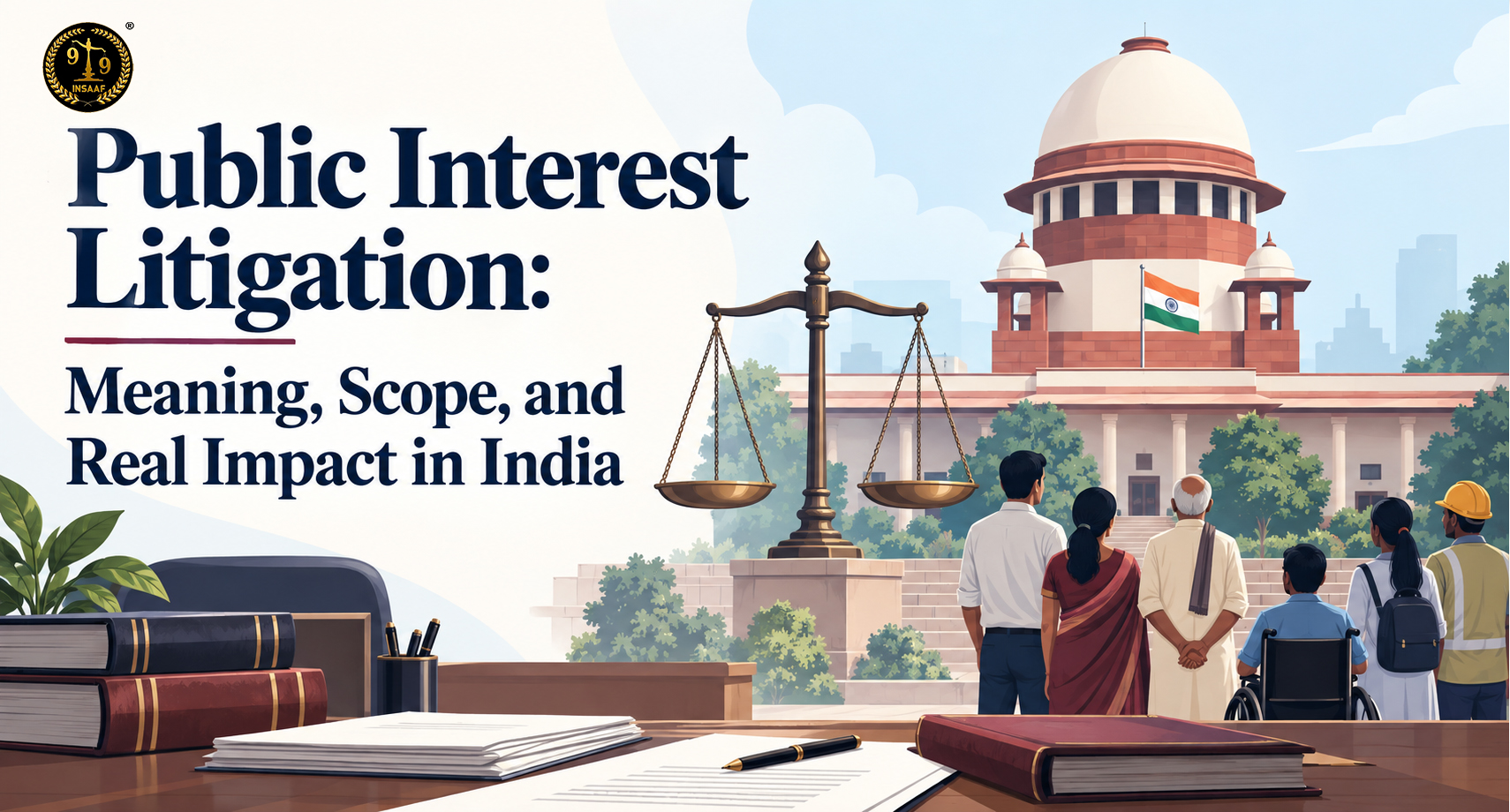
Imagine this in a government construction site in rural Bihar: team of laborers - goes months without pay, housed in shanties, and lacks basic sanitation. No one of them is able to pay a lawyer. Even they are not aware that they have legal rights. However, somehow their case is taken to the Supreme Court of India. A social activist, who does not know any of those workers personally, comes to the court and submits a petition on behalf of those workers. The court hears it. Action follows.
Such is public interest litigation, not as such a concept of the law, but as such a breathing, living, working tool of justice.
The meaning of public interest litigation is simply a legal process that permits any person who has a sense of the common good to go to a court of law not to seek a personal redress, but to defend a person or group, or even the rights of the constitution. The Latin term locus standi (the right to sue something in a court) has long been understood as requiring the individual who initiates a lawsuit to have a personal interest in the problem, PIL breaks that requirement.
Technically, what is public interest litigation? It is a petition which is presented to a High Court or the Supreme Court of India and the petitioner asks the court to interfere judicially in an issue that concerns the general population especially the people in the society who are not in a position to approach the legal system. The court is in most aspects the final protector of constitutional rights of the voiceless.
It is not there to solve property issues among neighbours or to clear personal differences. The whole idea behind it is more expansive, to make power answerable when all other avenues have been unsuccessful.
Also Read :- Land Acquisition Act 2013
Public interest litigation did not come about through a bill in parliament or a bureaucratic circular. It was a result of judicial frustration - a realization that the legal system on record, with its charges, procedures, language barrier, was merely beyond the reach of most Indians.
The turning point was in the 1980s. The pioneers of PIL in India are commonly known as justice P.N. Bhagwati and justice V.R Krishna Iyer. They noted that rights under the constitution were worthless when they were enforced by the rich and the learned. In a successive action of gradual decisions, the Supreme Court opened the doors to the letters, postcards, and telegrams as petitions, in other words, saying: we can listen to you, should you be able to write to us, about a real injustice.
This was judicial activism at its best. What the court was not merely doing was interpreting law but opening access to justice in a country where access to justice had never been fairly shared. The forced labour, the conditions in prisons, child abuse, the devastation of nature, all these things, which had been overlooked by the legislators and the administrators, found their way to judges, who were ready to take action.
In the subsequent decades, PIL shifted into becoming a constitutional tradition out of a procedural novelty. It turned into one of the hallmarks of Indian democracy - the testament to the fact that the judiciary could do much more than being the mechanism that could help to settle a specific dispute, but also act as the guarantor of basic rights.
A number of attributes distinguish PIL with respect to a normal civil litigation, and knowledge of them is what explains the reason why PIL has become such a potent instrument.
You need not yourself be aggrieved. The teacher in Pune can use a PIL concerning the polluted rivers in Assam. An ex-bureaucrat can approach the court regarding bonded labour in Rajasthan. The relationship is not personal injury, but the true concern of people.
PIL is economical to file court fees. In other instances, the Supreme Court has even considered informal communications as PIL petitions. This reduces the financial barrier to a large extent.
They are nearly always concerned with disadvantaged or marginalised groups of persons who, by accident or lack of education, or by poverty, cannot claim their rights in the usual legal means. That way, PIL is deliberately asymmetric. It balances out the current injustice system inequities.
A PIL can be filed by any citizen who has a good interest in the general population. That is a phrase - sufficient interest. The courts have always believed that the petitioner has to be interested in the welfare of the people and not a personal or business interest.
The common petitioners are NGOs and civil society organisations. So, do journalists, lawyers, academics and retired government people. A PIL may be presented by someone who is a private person, and perhaps has no legal qualifications, so long as the matter is a matter of public concern.
Credibility and goodwill are what courts seek and not credentials. Is the petitioner making a factual issue?
PIL in India is allowed in two levels. Article 32 of the Constitution allows a petition to be presented directly at the Supreme Court to have fundamental rights enforced. It may be brought before any High Court under Article 226 in both fundamental rights violation as well as other offenses.
It is a quite simple process. The petitioner writes the petition, and pays a nominal court fee and files the petition and affidavits in support of the petition. The court next makes a decision of whether to give notice to the respondent- typically the government or a government agency- and whether to continue with the case.
PIL in India is very extensive. Courts have heard petitions over the decades in which:
Environment: In PIL concerns such as deforestation, pollution of rivers, industrial wastes and the quality of the air are all taken to the courts.
Human Rights: Judicial intervention on issues of human rights such as custodial deaths, overcrowding in the prison, child labour, and cases of trafficking have come about due to PIL petitions.
Corruption and government malfeasance: Anomalies at the government procurement, mishandling of government funds, and lack of action by the administration is one path that has been pursued through this.
Health and Public Safety: The adulteration of food, negligence in a hospital, and pandemic containment have also been subject to PIL dockets.
The actual thing is that it should have relevant public interest and constitutional rights. When it actually has an impact on the people, then there must be a PIL angle.
Take the example of Sheela Barse, a reporter who addressed a letter to the Supreme Court on the situation where women were detained in the police custody in the state of Maharashtra. Her letter was treated as a PIL by the court, directions were given and a nationwide scrutiny of the practices of custodianship of women was initiated.
Next comes the Vishaka case - a PIL petition that was filed when a social worker was gang raped in the state of Rajasthan. The reaction of the Supreme Court was historic. Without a sexual harassment law in the workplace, the court itself issued binding principles, subsequently referred to as the Vishaka Guidelines that governed workplaces more than one decade until a Parliamentary law was enacted.
Or take the Oleum Gas Leak case in Delhi, where a PIL caused the Supreme Court to enunciate the principle of absolute liability that is an industry is held to be responsible for hazardous activity irrespective of negligence. The given principle transformed the law of industrial safety in India.
All these evolutions were not the work of Parliament or the government. They were brought by those who were concerned to visit the court.
PIL in India has always fulfilled three roles that none of the other legal mechanisms plays as effectively. It allows accountability, particularly when executive and legislative institutions slow down, become compromised or apathetic. The courts have intervened to check environmental compliance, reforms in prisons and integrity in elections due to the filing of a PIL by somebody.
It helps promote social justice by providing constitutional force to the rights that are on paper but not in practice. Article 21 has had its right to life expanded radically by the PIL to incorporate the right to livelihood, clean air, education and dignity.
Above all, it is an empowerment of citizens whereby ordinary citizens can make the state accountable via law.
All PILs are not noble. Not all the petitioners are crusaders. Courts have over the years consistently pointed out the abuse of PIL to serve personal vendettas, political scores, corporate rivalry and even in an act of pure publicity. The Supreme Court has levied penalties on the frivolous petitions and cautioned, on more than one occasion, that the machinery should not be turned into an instrument of harassment.
A weapon to provide voice to the voiceless is at times weaponised by those who already have plenty of voice.
Also Read :- Public Trademark Search in India
Insaaf99 an online legal consultation platform helps individuals and groups in filing a Public Interest Litigation (PIL) by making legal support easily accessible and affordable. Insaaf99 connects users with experienced and skilled lawyers who can assess and evaluate whether an issue qualifies for PIL, ensuring that genuine public concerns are addressed.
The platform also helps in simplifying documentation by guiding users on drafting petitions, collecting evidence, and understanding court procedures. It also reduces costs and time barriers through online consultations, making legal help available without physical visits.
Insaaf99 also offers clarity on legal rights and processes, Insaaf99 empowers citizens to raise issues affecting marginalized communities and contribute to justice in a structured, effective way.
Justice, in India, has never been evenly distributed. It has always required someone to fight for it — a lawyer who believed in a cause, a judge who refused to look away, a citizen who decided that silence was no longer acceptable.
Public interest litigation didn't just create that impulse. It simply gave it a legal address.
As long as there are people willing to knock on the court's door for those who can't, PIL will remain one of the most quietly radical features of the Indian Constitution. It is not just a legal remedy, but a statement about what kind of democracy India aspires to be.