
Online Legal Advice from Insaaf99® Online Lawyer Consultation in India
Online Legal Advice from Insaaf99® Online Lawyer Consultation in India
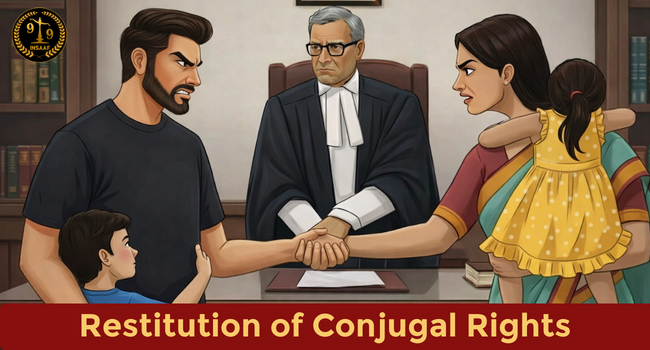
Can a spouse be legally enforced to cohabit with the other? This inquiry brings us to a disputed doctrine of restitution of conjugal rights. What is noteworthy in this case is the remedy that is under Indian matrimonial law, it can influence relationships, oppose individual freedom, and become a highly debated matter.
Restitution of conjugal rights is a compelling legal instrument that is applied decisively in a culture whereby, marriage is a legal and social institution that supposedly seeks restoration of marital harmony. However, its applicability is increasingly doubted due to the transformation of the rights of individuals and the shift in the social perceptions. In this article we will explore, intent, legal history, notable precedents, foreign viewpoints, social censure, and contemporary applicability of restitution of conjugal rights under the Indian law.
The meaning of conjugal rights is quite simple: this is a juridical right, and with the help of which a married partner may address the court with his/her petition requesting the spouse that has left without providing any reasonable ground to start living with him/her and do all the things of a married partner. It all comes down to salvaging marriages on the verge of collapse, promoting reconciliation, and dispelling the unreasonable abandonment.
Nature of the Remedy
• Unpunitive (civil) in nature.
• Both husband and wife may have access to it.
• Concentrates on social and legal reconstitution of marriage.
Key Aspects
• It does not impose sexual intercourse or the physical embraces - just the re-establishment of cohabitation.
• The question that the courts usually consider is if the withdrawal was without reasonable cause.
• Can be the antecedent of other marital events such as divorce or court parting.
Also Read :- State of Domicile in India
Section 9: The Core Provision
Section 9 of Hindu marriage act, 1955 forms the major statutory foundation of the restoration of conjugal rights in India. It reads:
Withdrawal by either spouse without any reasonable cause, allows an aggrieved party to seek the decree of restitution of conjugal rights by petition to the court of law at the district level which in turn will order the application to be given to the court and on being satisfied of the truth of the statements given in the petition and that there is no legal reason as to why the same should not be granted.
Essential Elements
• The existence of a legal marriage has to exist.
• One of the spouses must have retired out of the society of the other without a valid reason.
• The other husband or wife should petition the court.
• The court should be assured that there is no legal reason as to why the refusal should be made.
• It is also provided in other personal laws, such as Section 32 of the Indian Divorce Act (Christian law), and Section 22 of the Special marriage act.
Restitution of conjugal rights within the sphere of Indian jurisprudence is conditioned by the cases that have impact and significance in reference to privacy, liberty, and extent of the matrimonial remedies.
T. Sareetha vs. T. Venkata Subbaiah (1983)
In this case of the Andhra Pradesh High Court, Section 9 was taken to court on the question of its constitutional validity. Justice P.A. Choudary was of the opinion that the provision infringed the right to privacy and human dignity under Article 21:
• Forced restitution may imply forced sexual intercourse, which is a violation of bodily autonomy.
• The highest court perceived the remedy as an indignation on individual freedom which was against the constitutional values.
This judgment raised controversy in the country, and subsequently the Supreme Court reversed the judgment in Saroj Rani v. Sudarshan Kumar Chadha (1984).
Saroj Rani v. Sudarshan Kumar Chadha (1984)
Section 9 was reinstated in federal law by the Supreme Court, being described as constitutional. Key findings included:
• The decree is like a reconciliation measure rather than a coercion measure.
• Courts are not physically able to enforce cohabitation and act against autonomy; the inability to do so has purely civil repercussions.
The purpose of section 9 is to safeguard the sanctity of marriage and avoid desertion and not to infringe on the right to privacy.
Courts remain careful in granting this remedy, mindful of facts and allegations of cruelty, incompatibility, or abuse.
Workings Process:
Let us take an example, a married woman runs out of matrimonial home with false reasons of dissent but no genuine reasons. Under Section 9, her husband makes a petition. The court evaluates the evidence of both parties:
• Did she retire without justifiable cause?
• Are accusations of cruelty or abuse proved?
• Can it be somehow reconciled, or is the marriage beyond saving?
According to the facts, the court can issue restitution, a decree to the wife to return. In case she persists further, her noncompliance can be used as evidence in future divorce proceedings, but she cannot be kept in jail.
United Kingdom
In the UK, conjugal rights had been abolished under the Matrimonial Proceedings and Property Act, 1970:
• The idea was regarded as old fashioned, unrealistic, and against the new ideologies of marriage which was founded on partnership rather than coercion.
• The current law on the UK family puts more focus on consent, welfare, and personal freedoms rather than the restoration of marital unity by making such relationships legally binding.
Indian Perspective
India is an exception in restitution retention which is termed as a remedy in various personal laws such as Hindu, Christian and Parsi laws. This is justified by social harmony and preservation of marriage but critics doubt its relevance in a constitutional system that upholds autonomy and dignity.
The petition of restitution may be opposed by the respondent spouse, on sound grounds, which include:
• Cruelty by the petitioner
• Adultery
• Serious incompatibility
• Grounds to do with health, such as communicable disease.
• Any other reasonable cause as held by courts.
This makes sure that the remedy does not come in the form of an unconditional order, but will be weighed on a just examination of the circumstances in marriage.
For Legal Advice Online Contact Insaaf99
The main criticism of the restitution of conjugal rights is that it may contravene the key right, especially the Article 21 of the Indian Constitution that provides the right of life and personal liberty.
Criticisms
Possibility of gendered violence: This is frequently used against women, which forces them to go back to abusive relationships.
Invasion of privacy: Coerces one party to be associated closely, this may be against their will.
Old-Fashioned Morality: The legislation interprets marriage as an everlasting contract which binds cohabitation rather than partnership of mutual agreement.
Support
• To guard against useless and unwarranted desertion, safeguard family units.
• Perceived as a final effort to conserve marriage until it is allowed to be dissolved.
Restitution is considered constitutional in the Indian courts, and in the post-Saroj Rani period, the courts generally endorse restitution as long as it is not abusively practiced and, it is not practiced by physical coercion.
Contemporary Vision: Changing Values and Significance.
The current world is shifting towards social attitudes and legal priorities. Equality between the genders, privacy standards, live-in relationships, and enhanced independence have kept the restitution of conjugal rights into question.
Gender Equality:
According to the women right’s activists, the law tends to intimidate wives and this is a patriarchal mechanism which is incompatible with the current concept of equality and consent.
The Live-in Relationships Coexist with Coexistence.
The increased tolerance to non-marital cohabitation also casts doubt on the applicability of the law, in many cases marriage is not the only valid family unit.
Conjugal Rights Restitution: Ethical and Social Implication.
Restitution of conjugal rights is in the gray area between enforced by the law and ethical gray area:
• The remedy is based on social norms that endorse the remedy as a family bonding factor.
• Freedom of legal coercion is occasionally required by individual well-being, autonomy and privacy.
The Law in Practice
• It is used seldom as a lever in complex matrimonial conflicts.
• Becoming less and less esteemed, particularly among the younger and urban population.
Potential for Misuse:
• Weapon in matrimonial litigation--resort to so as to prove desertion or have an advantage.
• The cases recommending the exercise of caution are cases in which reconciliation is obviously impossible, or where the safety of self is imperiled.
Also Read :- Rights Against False Promise of Marriage
The Indian matrimonial law of restitution of conjugal rights is an effort to bring together legally separated spouses without reasonable cause. Although the Hindu marriage law, Section 9 of the Hindu marriage act, 1955, and others of its analogs in other personal laws offer marriage saving measures, the doctrine is increasingly being subject to criticism in terms of privacy, autonomy, gender justice, and modern social norms.
FAQs
Q1: Landmark Judgments on Restitution of Conjugal Rights
Ans:
• T. Sareetha v. T. Venkata Subbaiah (1983) – Andhra Pradesh High Court held Section 9 unconstitutional for violating privacy and human dignity.
• Saroj Rani v. Sudarshan Kumar Chadha (1984) – Supreme Court upheld Section 9’s validity, calling it a means to preserve marriage.
• Harvinder Kaur v. Harmander Singh Choudhry (1984) – Delhi High Court upheld Section 9 as constitutional, rejecting the privacy argument.
Q2: Restitution of Conjugal Rights under Muslim Law
Ans: Under Muslim law, either spouse may seek restitution if the other withdraws from cohabitation without lawful reason, unless justified by cruelty or ill-treatment.
Q3: What Is Restitution of Conjugal Rights under Hindu Law?
Ans: Under Section 9 of the Hindu Marriage Act, 1955, a spouse may seek restitution if the other withdraws from cohabitation without reasonable cause