
Online Legal Advice from Insaaf99® Online Lawyer Consultation in India
Online Legal Advice from Insaaf99® Online Lawyer Consultation in India
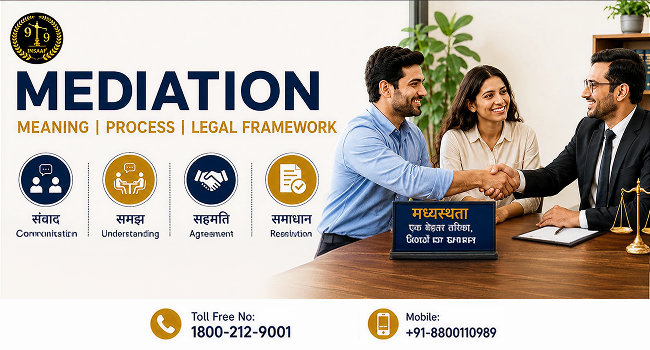
In various phases of our life we require conflict resolution. It is very important as conflicts are inevitable whether it is a conflict between entrepreneurial partners having a clash of strategy. A divorcing couple is fighting for custody. A conflict arises between an employer and an employee on termination. A neighbour feels wronged. Conflict is evident wherever there is an overlap of human interests.
For decades, the litigation has reigned in that area of conflict resolution. The law courts were the places where conflicts were contested, written down, ruled and stored. And as time passed by people started to ask another question:
Is there a better way?
The above question led to the increasing significance of the mediation process - a phenomenon that is redefining the way contemporary societies handle conflict.
In its most basic form, mediation refers to a formal and private act where a third party helps in the process of settling disputes between disputing parties through facilitation by a neutral third party.
However, that is technically accurate but that is not the depth of it.
When a person will say, what is mediation? they are frequently demanding more than a definition. They are asking:
• Is this legally binding?
• Is it enforceable?
• Is it fair?
• Does someone win or lose?
• Is it inferior to court attendance?
The reality is this:
Mediation does not entail a measure of weakness. It is about control.
In comparison with litigation when a judge makes a decision, in mediation parties themselves are able to design their own outcome. The mediator does not rule. The mediator guides. The mediator never made a declaration of fault. And that is the difference that alters all.
Also Read: - How to File for Divorce in India
The general meaning of mediation is described as intervening in a dispute in order to get an agreement signed. However, the real sense of it is much more than intervention.
Mediation represents:
• Structured negotiation
• Assisted communication
• Interest based resolution of conflict.
• A voluntary course to closure.
Arguments in litigation become sharped. Arguments are re-packaged and repackaged in mediation. In court, positions dominate. Interests come into play during mediation.
Whenever the interests are known, the solutions will be multiple.
Courts can award damages within the written rule.
Mediation, however, may develop compensation schemes, reorganization of businesses, future patterns of cooperation, apology, amended contracts, or existing schemes to save both parties.
The foundation of mediation can only be understood to grasp the mediation in depth. There are a number of guiding principles:
Voluntariness: Parties are usually willing attendants. Settlement, however, is also voluntary even where courts suggest mediation. No one can be forced to agree.
Neutrality: The mediator does not take sides. Their favouritism avoidance is the only attribute that gives them credibility.
Confidentiality: The discussions that are made in mediation are usually inadmissible at a later time in court. Such defence promotes openness and frankness.
Self-Determination: The result is an attribute of the parties. Not the mediator. Not the system.
These principles also make mediation different to the adversarial processes and especially to the disputes that are sensitive or relationship based.
Mediation is a process that is believed to be informal by many people. It is not. Although not as strict as a courtroom litigation, mediation has a systematic course.
Agreement to Mediate: Consent is the starting point of the process. Parties are voluntarily referred to mediation, or referred by a court. The choice of a mediator depends on his expertise, impartiality and accessibility.
One sets up ground rules. The terms of confidentiality are negotiated.
Opening Statements: Both parties give their account. This is not a combatant step as is the case with courtroom cross-examination. It is disciplined, deferential and non-verbal.
In many cases, this is the very first time that parties are listening to one another.
Joint Discussion: The mediator promotes communication. Within the scope of misunderstandings, it is clarified. Emotions are not ignored but are controlled. The mediator turns enmity to positive communication.
What is perceived as an accusation might gradually turn into an explanation.
Private Sessions (Caucus): The mediator can be meeting parties individually. Such meetings provide the possibilities to discuss the risks, expectations, and settlement possibilities in secrecy.
Here flexibility is apt to arise.
Negotiation and Drafting Settlement: Once a common ground is established, negotiations are made and terms are drafted into a written settlement agreement. The agreement may turn into a legally binding and enforceable agreement depending on jurisdiction.
Settlement of all mediation is not a complete settlement. However, the partial resolution implies that issues can be narrowed down and this saves a lot of time in litigation.
With the emergence of mediation in the global arena, governments realized that legal frameworks have to be in place to normalize and legitimize the process. It gave rise to the formulation of formal Mediation Acts in different nations.
As an example, in India, the Mediation Act, 2023 provided statutory support to mediation and formalized mediation councils and the enforcement of settlement agreements.
This act was a major milestone in the establishment of mediation in the Indian legal system, since there is an increasing number of cases that are backlogged in courts.
On the same note, in the United States, mediation has received support in the form of federal and state laws, court-approved programs of mediation and institutional rules of ADR.
And legal recognition gives:
• Settlement which is enforceable.
• Having specific mediator standards.
• Confidentiality protections
• Public trust in the process
Mediation can be informal without legal backing. It is a parallel support of justice with legislative support.
The law of mediation has changed substantially over the last few years, mediation in India has passed the stage of being mostly court-associated and practiced based on being a completely codified statutory process. Simultaneously, the international organizations and regional alliances have created models to normalize the cross-border enforcement and to unify mediation practices. A combination of these reforms is an indication of a world move towards making the mediation a system of dispute resolution that is structured, reliable and enforceable and not just an alternative one.
Major Amendments Under the Mediation Act, 2023.
• Mediations are given statutory recognition as the formal mechanism of dispute resolution.
• Orders the Mediation Council of India to control the accreditation and professional standards of the mediators.
• Brings about pre-litigation mediation (compulsory) on specific civil and commercial disputes (except at specified timelines and exceptions).
• Brings that the mediated settlement agreements are binding and enforceable as decrees of a court.
• Increases protection of confidentiality and sets out grounds that are limited in challenging settlements.
• Identifies online mediation and community mediation, and increases availability and online accessibility.
• Establishes a pattern of international mediation that takes place in India.
Singapore Convention on Mediation - Enables international commercial mediated settlements between signatory states to be directly enforceable.
United Nations Commission on International Trade Law (UNCITRAL) Model Law on International Commercial Mediation - Gives harmonization to the legislation adopted by various jurisdictions.
European Union Mediation Directive (2008/52/EC) - Advocates mediation of civil and commercial disputes in the EU member countries.
The systems of court-annexed mediation that have become common in the United States and the United Kingdom are systems that introduce ADR into the routine administration of the courts.
International interest in online dispute resolution (ODR) to facilitate cross-border and digital trade dispute management.
Together, these developments reflect a global shift toward institutionalized, enforceable mediation as a mainstream dispute resolution mechanism.
The distinction between litigation and mediation is not procedural. It is philosophical. Litigation is adversarial. It is done based on proof, evidence, and legal rights. Mediation is collaborative. It is based on discussion, negotiation and mutual interests.
| Litigation | Mediation |
| Public proceedings | Private process |
| Judge decides outcome | Parties control outcome |
| Lengthy timelines | Often quicker |
| High costs | Typically, cost-effective |
| Rigid remedies | Flexible solutions |
Mediation has already been successful in a variety of industries:
Family Disputes: Divorce, child custody, inheritance. Mediation minimizes emotional traumas and gives the co-parenting arrangements an opportunity to be drawn up concurrently.
Business and Company Law: Disagreements between shareholders, breaking of partnership. Companies prefer seclusion and effectiveness.
Workplace Conflicts: Sexual harassment issues, unjustified dismissal, internecine conflicts. Frequently, mediation helps to avoid reputational harm and protracted HR debates.
Community Disputes: Medication works well in your local disputes, property issues and disputes within community living.
Cross-Border Disputes: The flexibility and impartiality of mediation are beneficial to international commercial conflicts; particularly where jurisdictional problems are involved.
In these areas, the same theme is easy to see: mediation saves face.
The mediation advantages are both physical and non-physical.
Speed: Criminal cases are protracted. Mediation normally ends in weeks or months.
Cost-Effectiveness: The court expenses, legal charges, and time wasted in courts are greatly minimized.
Confidentiality: This is the best thing about disputes that the issue discussed remain private.
Flexibility: Strict legal remedies are not constrained in offering solutions.
Control: The parties make their own fortunes.
Relationship Preservation: Probably the underestimated advantage. Mediation does not involve long-term hostility.
This is an advantage that can hardly be overemphasized in a world in which reputation and relationships are crucial factors of life.
The Limitations and Risks:
Mediation is effective, but not omnipresent, it may be unsuitable where:
• One of the parties is not bargaining in good faith.
• There are extreme imbalances of power.
• There is involvement of criminal behaviour.
• There is a need to have urgent judicial orders.
Also, when a settlement is not drafted correctly, one can also face difficulties with enforcement.
The Psychology of Humanity behind Mediation.
Why does mediation work? Most conflicts are not legal as such, they are emotional.
• Broken trust is behind all the contract disputes.
• In the background of any employment dispute, there is the sense of injustice.
• History and hurt is behind all conflicts of the family.
The legal liability is handled in the courts. Mediation is a solution of human reality. A good mediator is one who listens to the people, reformulates accusations, and unearths the latent interests.
Also Read: - Restitution of conjugal rights
What is mediation?
• It is structured dialogue.
• It is assisted negotiation.
• It is a conflict resolution that is based on consent and not coercion.
Mediation has taken a central stage as backed up by such frameworks as the Mediation Act and being adopted by various industries. It is not a guarantee of a consensus. It does not overcome conflict. But it is something worth much; it is an opportunity to work out conflicts without ruining relations. And in a world that is more and more characterized by division, that can be its best contribution of all.
FAQs
Q1: How much does mediation cost in India?
Ans: Court-annexed mediation is usually free or low-cost. Private mediation typically ranges from ₹5,000 to ₹50,000+ per session, depending on the mediator and dispute complexity.
Q2: Four types of mediation
Ans:
1. Facilitative
2. Evaluative
3. Transformative
4. Narrative
Q3: Is mediation legally binding in India?
Ans: Yes. Under the Mediation Act, 2023, mediated settlement agreements are legally binding and enforceable like a court decree.