Scan this QR Code to download the App
2025-Nov-18
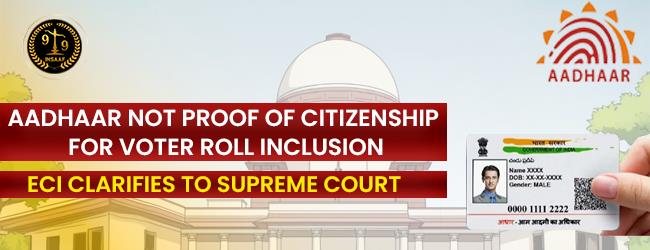
The Hon’ble Supreme Court observed that Aadhaar is used only as a proof of identity, not as proof of citizenship, when applying for inclusion in the electoral roll. The clarification was given during the hearing of a petition challenging the use of Aadhaar details in Form 6 for new voter registrations.
To strengthen its stand, the ECI invoked Section 23(4) of the Representation of the People Act, 1950, that permits electoral officers to collect aadhaar details solely for verifying identity and preventing duplication of voters. The Commission insisted that it could not consider aadhaar as evidence of citizenship or eligibility to vote. This view is supported by Section 9 of the aadhaar Act, 2016, which categorically states that Aadhaar shall not be proof of citizenship, date of birth or address.
Key Takeaways Embedded Within Context
• Aadhaar can only establish identity, not citizenship, for voter-roll inclusion.
• Statutory law has restricted Aadhaar's role in electoral processes.
• ECI's recent instructions, however, (Sept 2025) advise all electoral officers not to treat Aadhaar as proof of citizenship or eligibility.
Judicial precedents were also referred, including judgments of the Bombay High Court and Hon’ble Supreme Court of India, on the issue that Aadhaar cannot be considered valid for determining age or citizenship. Even in a recent review by Hon’ble Supreme Court in connection with revision of the voter list in Bihar, it had said that Aadhaar should only facilitate identification.
It came in response to a petition filed by Ashwini Kumar Upadhyay, who said linking Aadhaar details with the voter registration process is not in order. The ECI, however, remains firm in its stand that its present system is in tune with the law and that the Aadhaar data are utilized strictly within their legal boundaries.
What Can Legal Professionals Help You With? Connect with independent legal professionals through our platform in minutes to discuss your legal questions and explore your legal options.





Copyright ©️ All rights reserved with JKM Global Services LLP
 Whatsapp
 CALL NOW :-
8800110989
CALL NOW :-
8800110989
 Toll Free :-
1800-212-9001
Toll Free :-
1800-212-9001


 +91-8800110989