
Scan this QR Code to download the App
2026-Sep-03
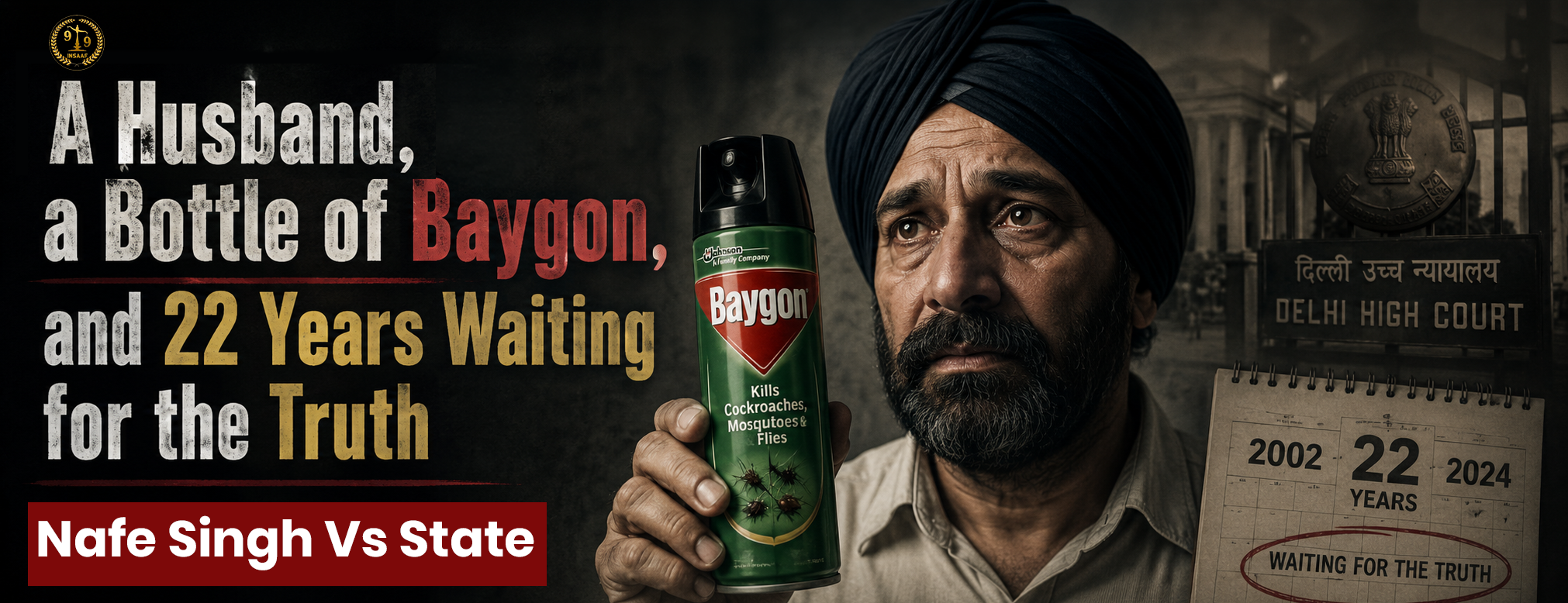
A marriage breakdown can easily become devastating in a courtroom battle rather than a sitting counsellor's office. This is exactly what happened to Nafe Singh, a Delhi man who had to battle a criminal case for more than 20 years, which could have landed him years of jail time. In the report of its verdict in Nafe Singh v. The Delhi High Court started its judgment on a philosophical note, stating that a couple's “better half” can become his/her “bitter half” if the marital problems are not resolved timely before acquitting him, more than twenty-two years after the incident. The reasoning behind that decision reads almost like a masterclass in why "he said, she said" isn't enough to convict someone in a court of law.
What Actually Happened
Nafe Singh and Asha were married in March 2000. As the judgment itself notes, married life started out fine but soured within a year. The area of conflict was rather mundane for Indian households at the time: Asha wanted to get married and live on her own with her husband, away from her widowed mother, and she also wanted a piece of the family property registered in her husband's name. Nafe Singh wasn't happy about it.
Then one day on 20 April 2001, things allegedly started getting rough. Asha complained that Nafe Singh had tried to make her drink the liqueur Baygon, a common household insecticide spray, from a steel tumbler when he was having an argument with her, then he poured it straight into her mouth.
She was taken to a hospital in an ambulance. A First Information Report (FIR) was lodged in the police against Nafe Singh and his mother, alleging that they were guilty of attempted murder (307) and cruelty (498-A) under the Indian Penal Code (IPC).
The Trial Court's findings on the issue are as follows:
The trial court acquitted Nafe Singh and his mother of the charge of cruelty in 2004, concluding that the story about the dowry wasn't convincing. It, however, has found Nafe Singh guilty of the attempted murder charge and has sentenced him to three years rigorous imprisonment. He appealed — and waited more than twenty years for his appeal to be decided.
Why the High Court Overturned the Conviction
The interesting part of the case is that the High Court didn't just believe Asha's version over Nafe Singh's. It scoured the medical literature — and what it uncovered didn't make sense.
The symptoms were not suggestive of poisoning. Asha arrived at the hospital and all her vitals – pulse, blood pressure, breathing, alertness – were found to be normal. No vomiting, no difficulty breathing, no confusion — none of the symptoms usually associated with insecticide poisoning. The court even referenced a published medical study on pyrethroids (the chemical class that contains Baygon) poisoning that says nausea, breathing trouble, shakes and seizures are possible symptoms based on the dose. Not a bit of it was in Asha's case, apart from a fleeting reference to vomiting in the casualty ward.
There was no report of anything in the laboratory. The doctors had taken a sample of the stomach wash (known as a gastric lavage) and forwarded it for forensic testing. The report was negative, no sign of poison at all.
A contradiction no one could elucidate. The Baygon container that was found at the scene was empty, the investigating officer said. However, the report from the forensic lab placed on the container revealed the presence of approximately 4 ml of insecticide. No one in the prosecution case ever said how an “empty” bottle could end up with liquid in it by the time it arrived at the lab.
The conduct of Nafe Singh had raised questions. It had been Nafe Singh who had called the police and rushed his wife to the hospital and hospital records revealed that he paid a ₹10,000 advance for her treatment. That's not exactly typical behaviour for someone who has just tried to kill his spouse.
Asha's evidence was discredited when she was cross-examined. In her first statement, she said the previous miscarriage was caused by her husband beating her. During cross-examination, she confessed the miscarriage was not caused by any beating, but rather was natural. She also accused her husband and his family of spreading rumours about her reputation in the area and said she had never heard them say anything like that — but she later admitted in cross-examination that she had never heard her husband say that. She stated that dowry (scooter) was demanded, but did not provide any information or date.
The Bigger Legal Point
The judgment throws light on the approach Indian courts must take in weighing “intention” in attempt-to-murder cases. Just saying that someone did an act does not mean that it is considered murder — the prosecution has to prove that the accused intended or knew that the act would have caused the death of the person if he or she had actually died. Justice Vimal Kumar Yadav cited Supreme Court precedent to emphasise that it was not enough that an accusation was made, the intention had to be inferred from the overall picture — the weapon, the way it was used, the motive and what preceded and followed — in that case.
The Verdict
Given this lack of medical evidence, the clean crime scene paperwork, the bottle's story and the witnesses, the High Court concluded that the prosecution had failed to prove its case beyond reasonable doubt. Nafe Singh was found not guilty and his bail bonds dismissed.
It's a reminder that even though couples may be bitter with each other, it doesn't mean they are guilty or that accusations can stand on their own in a court of law without solid facts to support them.
What Can Legal Professionals Help You With? Connect with independent legal professionals through our platform in minutes to discuss your legal questions and explore your legal options.






Copyright ©️ All rights reserved with JKM Global Services LLP
 Whatsapp
 CALL NOW :-
8800110989
CALL NOW :-
8800110989
 Toll Free :-
1800-212-9001
Toll Free :-
1800-212-9001


 +91-8800110989