
Scan this QR Code to download the App
2026-Aug-26
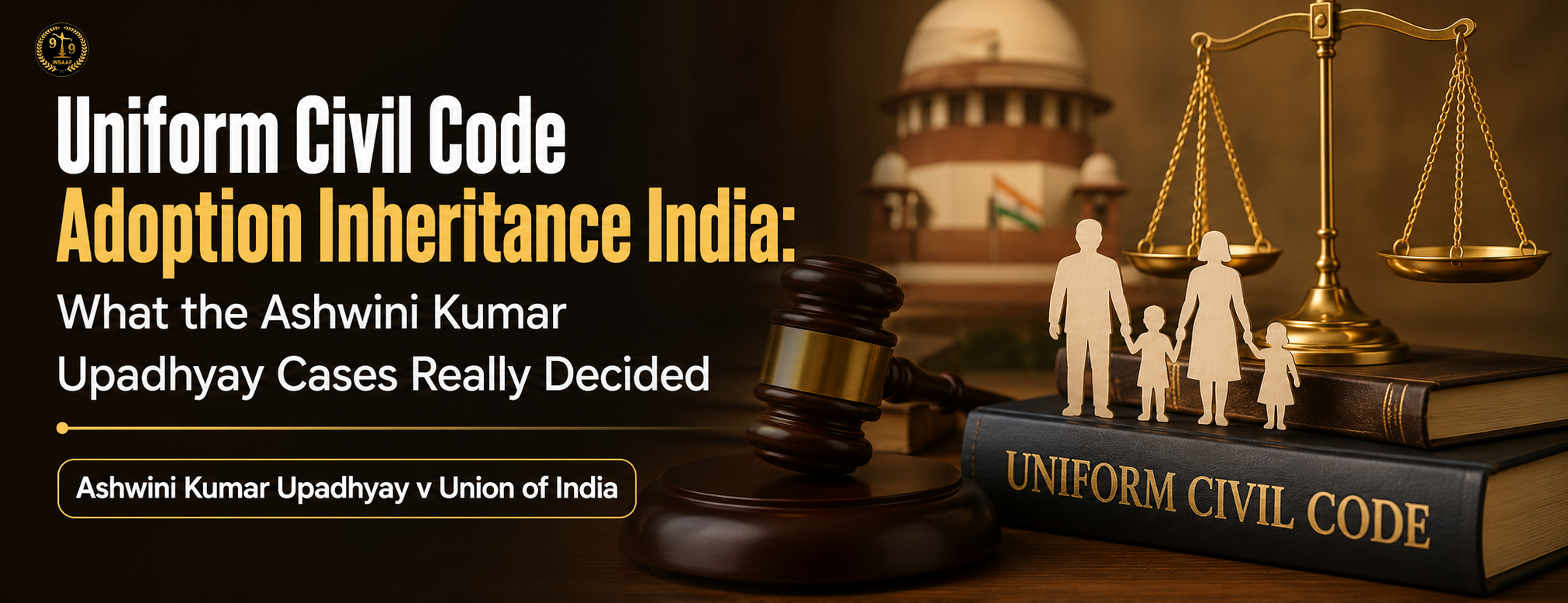
Ashwini Kumar Upadhyay filed Petitions in the Supreme Court for uniform adoption/guardianship/succession and inheritance laws in India on the ground of disparity in the laws of different religions for adoption, guardianship, succession and inheritance. The Supreme Court refused to hear these petitions on 29 March 2023, saying it was for the legislature to decide if such a uniform law should be enacted, rather than the judiciary asking the question whether the personal laws are discriminatory or not.
Adoption, guardianship, succession and inheritance relate to personal occasions and moments in an Indian family life, such as who can adopt a child, who can inherit a house, who is next of kin. There are no uniform rules in India for these issues, and the responses may vary based on the personal law that is applicable to an individual's religion. This is the same Uniform Civil Code (UCC) gap which the lawyer and BJP leader Ashwini Kumar Upadhyay sought to take up at the Supreme Court – the idea of a single set of civil laws for everyone, irrespective of their religion. The state is bound to do everything it can to achieve this goal, but Article 44 of the Constitution also has this quality of Directive Principles, meaning that it is not a right that the courts can enforce.
The petitions raised constitutional questions around equality, non-discrimination, personal liberty and the goal of a Uniform Civil Code. The arguments primarily referred to the following provisions of the Constitution of India:
Article 14 – Guarantees equality before the law and equal protection of the laws.
Article 15 – Prohibits discrimination on specified grounds, including religion and sex.
Article 21 – Protects life and personal liberty.
Article 44 – Directs the State to endeavour to secure a Uniform Civil Code for citizens throughout India.
Between 2020 and 2021, Upadhyay filed multiple writ petitions addressing various aspects of family law—marriage, divorce and maintenance, adoption and guardianship and succession and inheritance. Adoption and guardianship & succession and inheritance the two made the case that the current fragmented state of the personal laws based on religion leaves the door open for unequal treatment based on faith and gender.
Uniform Adoption and Guardianship: What Was at Stake
There is no uniform law for adoption. Under the Hindu Adoptions and Maintenance Act, 1956, and the Hindu Minority and Guardianship Act, 1956, adopted children are treated like biological children in matters of inheritance and family status for the Hindus. The personal laws of Muslims, Christians and Parsis do not have anything similar to that framework and it is not an impediment to the communities to raise a child as their own; the framework of the secular Juvenile Justice (Care and Protection of Children) Act, 2015, is open to all for formal adoption.
Upadhyay contended that even if adopted children are governed by the Indian laws, their outcomes would be inconsistent for equally situate families, denying them equality (Article 14), non-discrimination (Article 15) and dignity (right to life, Article 21), especially to women, and consequently Article 44 was also violated.
Uniform Succession and Inheritance: The Core Argument
The inheritance in India is a subject which is governed by several laws like Hindu Succession Act, 1956, Indian Succession Act, 1925, and Muslim Personal Law (Shariat) Application Act, 1937, etc. The petition highlighted certain differences: In personal law, a son would generally receive two-thirds of his father's estate, while in Muslim law, the testator is allowed to distribute no more than one-third of his assets through a will. In contrast to Hindu law, in which a person may give away all property acquired by them through a will.
In these differences Upadhyay relied on Article 14, 15, 21 to contend that it creates discrimination on religious and gender grounds and the equitable treatment is linked to the dignity of women.
The two petitions were heard together and on 29 March 2023, a bench of three judges headed by D.Y. Chandrachud, CJI, and Justices P.S. Narasimha and J.B. Pardiwala, ruled that they were not fit for consideration under Article 32. This was not a decision of constitutionality or lack thereof between the differences in personal laws. The bench noted that it was not within the competence of the judiciary to decide on enacting a law to align various personal law regimes with a civil code.
The Court did not find personal laws to be discriminatory, nor did it say that they were valid and not subject to challenge. It merely refused to apply its writ powers to enforce a uniform code, and that was up to the elected legislators. The Article 44 does not compel an immediate UCC — it is a call for Parliament to act upon.
The outcome of 2023 does not end the UCC conversation but rather brings it to Parliament. The debate goes back to the 1948 constituent assembly and took a boost from the Supreme Court's 1985 Shah Bano judgement on maintenance for Muslim women. The UCC has been a part of the BJP's platform since 1998 and women rights organisations have been split between seeing the organisation as an expression of gender justice and worry about the majoritarian agenda behind the latest campaign.
Conclusion
The Ashwini Kumar Upadhyay cases clearly brought to light genuine and documented differences in India's personal law systems and questions were constitutionality raised under Article 14, 15 and 21. In the procedural judgement of March 2023, however, the Supreme Court had affirmed that it does not have the authority to design a uniform civil code for India by itself – this is a matter for the legislature.
FAQs:
Q1: What was the adoption petition about?
Ans: It questioned the disparity between the inheritance provisions made for the Hindu community and those of other communities through the secular Juvenile Justice Act, on the basis of the inconsistent results obtained.
Q2: What was the lawsuit about inheritance concerning?
Ans: Inheritance shares of sons and daughters as per Muslim personal law and the limits of testamentary freedom in Muslim law compared to Hindu law.
Q3: In 2023, the Supreme Court ruled on what?
Ans: It has rejected both petitions, saying on 29 March 2023 that the uniform civil code is a legislative, not judicial, measure.
Q4: Should there be an immediate UCC under Article 44?
Ans: No, it's a Directive Principle for policy, not a right that will be enforced on a specified timing.
What Can Legal Professionals Help You With? Connect with independent legal professionals through our platform in minutes to discuss your legal questions and explore your legal options.





Copyright ©️ All rights reserved with JKM Global Services LLP
 Whatsapp
 CALL NOW :-
8800110989
CALL NOW :-
8800110989
 Toll Free :-
1800-212-9001
Toll Free :-
1800-212-9001


 +91-8800110989